
Germany, like many industrialized nations, is facing the challenge of depletion of phosphorus resources and the growing burden of sewage sludge management. The nation faces an acute phosphorus dependency. They import over 100,000 metric tons of raw phosphate they need for fertilizer production. Meanwhile, the wastewater treatment plants in Germany generate vast quantities of nutrient-rich sewage sludge. This sludge is sent to landfill or incinerated, losing the valuable phosphorus forever. The Organic fertilizer from sewage sludge system for Germany is emerging as a transformative solution.
The Organic fertilizer from sewage sludge system for Germany converts waste into valuable agricultural inputs. This system addresses environmental concerns and contributes to a circular economy. Through the innovative machinery provided by LANE Heavy Industry, the transition from “waste management” to “resource recovery” is becoming a mechanical reality. This article explores how a specialized organic fertilizer from sewage sludge system for Germany can solve the phosphorus shortage and reshape the future of sustainable farming.
Phosphorus is an indispensable nutrient in agriculture which cannot be produced synthetically. European countries rely heavily on imports for phosphorus, which makes any disturbance of supply chains a weakness for Europe. On the other hand, Europe has created policies which limit traditional sludge disposal methods such as landfilling or incineration.
Germany has already taken regulatory steps to mandate phosphorus recovery from sewage sludge. This policy shift creates a strong demand for innovative systems like the Organic fertilizer from sewage sludge system for Germany.
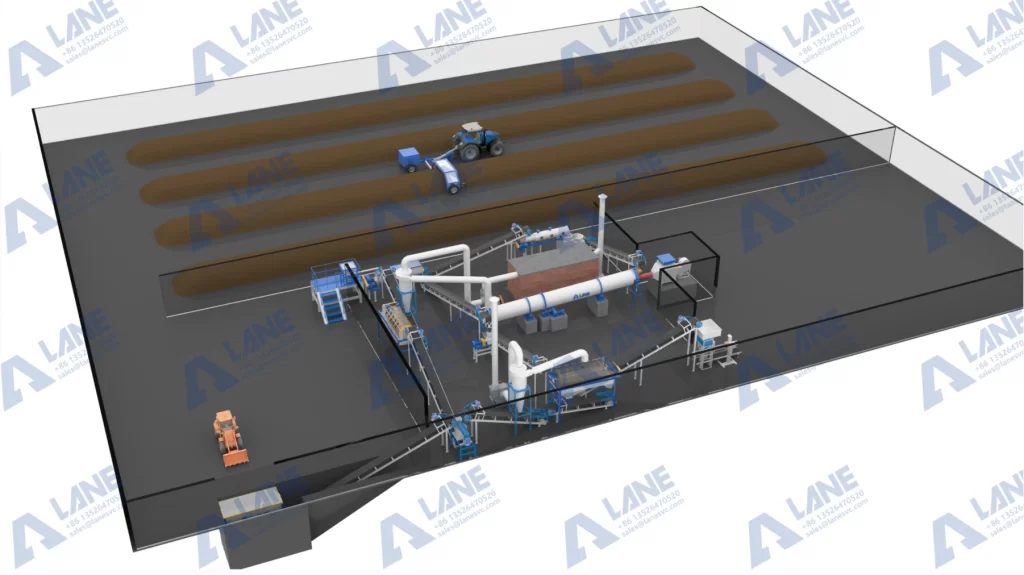
The Organic fertilizer from sewage sludge system for Germany is an integrated processing solution that converts dewatered sludge into stabilized, nutrient-rich organic fertilizer. It combines mechanical, biological, and thermal processes to ensure safety, efficiency, and product quality.
LANE Heavy Industry provides a complete production line designed for customization, safety, automation, and compliance with European standards. The system transforms sludge into marketable fertilizer granules suitable for agricultural use.
Transforming wet, pathogen-heavy sludge into clean, nutrient-rich pellets requires a clear process plan. LANE Heavy Industry has developed a specialized organic fertilizer from sewage sludge system for Germany that integrates several stages of heavy machinery into a seamless, automated production line.
The process begins with sludge dewatering. Raw sludge contains high water content, which must be reduced to a manageable level before fermentation. Within a comprehensive organic fertilizer from sewage sludge system for Germany, a specialized dewatering machine is used to prepare the material for the biological phase.
The heart of any organic fertilizer from sewage sludge system for Germany is the fermentation stage. LANE Heavy Industry provides high-capacity Groove Type Compost Turners, Disk Turners, and Crawler Compost Turners.
These machines ensure that the sludge is properly aerated and allow aerobic bacteria to break down organic matter and raise the temperature to 55–70°C. This natural heat kills pathogens and weed seeds, ensuring that the final output of the organic fertilizer from sewage sludge system for Germany meets strict European safety standards.
Once fermented, the material is often clumpy. A Semi-wet material crusher breaks down these blocks. In a high-end organic fertilizer from sewage sludge system for Germany, precise mixing is required to add supplementary nutrients like potassium or nitrogen to create a balanced fertilizer tailored to specific German soil needs. With the help of LANE’s mixing machine, you can create your own formula.
One of the biggest hurdles in using organic waste is the dust factor. Raw compost is difficult to spread with modern agricultural machinery. This is why the organic fertilizer from sewage sludge system for Germany developed by LANE Heavy Industry emphasizes high-efficiency granulation.
Using a professional organic fertilizer from sewage sludge system for Germany ensures that the pellets have the right density and moisture content to prevent crumbling during shipping.
Drying, Cooling, and Quality Control
After granulation, the granules typically contain 25-30% moisture. This moisture content needs to be reduced to prevent mold. LANE’s organic fertilizer from sewage sludge system for Germany includes a rotary drum dryer and rotary cooling machine.
The Organic fertilizer from sewage sludge system for Germany enables the recovery of phosphorus and other nutrients, reducing dependence on imports.
By converting sludge into fertilizer, the system minimizes landfill use and environmental pollution.
Composting and recycling processes lower greenhouse gas emissions compared to incineration.
Farmers gain access to cost-effective fertilizers, while municipalities reduce waste management costs.
Challenges and Considerations
Despite its advantages, implementing the Organic fertilizer from sewage sludge system for Germany involves certain challenges:
However, with proper system design and reliable equipment from LANE, these challenges can be effectively managed.
The circular economy emphasizes resource efficiency and waste minimization. The Organic fertilizer from sewage sludge system for Germany fits perfectly into this model by:
Germany’s commitment to sustainability makes it an ideal environment for the widespread adoption of such systems.
It is a production system that converts sewage sludge into safe, nutrient-rich organic fertilizer using advanced processing technologies.
Yes, the Organic fertilizer from sewage sludge system for Germany includes composting and treatment processes that eliminate pathogens and meet strict safety standards.
The system typically includes compost turners, crushers, mixers, granulators, dryers, coolers, screening machines, and packaging units.
By recovering phosphorus from sewage sludge, the Organic fertilizer from sewage sludge system for Germany reduces reliance on finite natural reserves.
Henan Lane Heavy Industry Machinery Technology Co., Ltd.
Email: sales@lanesvc.com
Contact number: +86 13526470520
Whatsapp: +86 13526470520