
Table of Contents
Corn is one of the most cultivated crops in the world. Corn stalk, a common agricultural waste, is often discarded or burned. This causes environmental pollution and resource waste. Organic fertilizer production from corn stalk has emerged as a sustainable solution that turns this waste into a high-value agricultural input. It solves the corn stalk disposal problem while providing eco-friendly fertilizer for crops which improve soil fertility. With the rise of organically produced food, farmers who want an alternative can use organic fertilizer production from corn stalk.
This guide provides details about commercial processes, cost-effectiveness, and the role of LANE Heavy Industry’s machinery in organic fertilizer production from corn stalk.
Corn stalks are rich in cellulose, hemicellulose, and essential nutrients like potassium and nitrogen. It is considered agricultural waste but now it can be transformed into high-quality organic fertilizer. Advantages of this fertilizer include:
These benefits make corn stalks an ideal raw material for an organic fertilizer production plant.
Organic fertilizer production from corn stalk involves carefully processing raw stalks into nutrient-rich granules suitable for crop application. The process includes:
LANE Heavy Industry’s organic fertilizer production line offers a fully integrated system that ensures high efficiency, product consistency, and scalability.
4.1 Collection and Preparation of Corn Stalks
The first step of fertilizer production is the collection of corn stalks after harvesting. They are then cleansed to remove impurities such as stones, soil, or other crop residues. Proper preparation ensures smooth operation in downstream processes and prevents damage to machinery.
4.2 Crushing and Size Reduction
Crushing is essential for improving the composting process. Corn stalks are fed into a LANE shredder to reduce size. Smaller particles increase surface area, promoting microbial activity and faster decomposition. It’s critical in organic fertilizer production from corn stalk.
4.3 Fermentation and Composting
Fermentation is the heart of organic fertilizer production from corn stalk. In this process, microorganisms decompose the organic matter and produce humus-rich material. This stage takes 15–45 days depending on the raw material, environmental conditions, and composting method. LANE Heavy Industry offers automated compost turners to maintain aeration and optimize fermentation.
4.4 Granulation Process
Granulation converts fermented corn stalk material into uniform fertilizer pellets. LANE Heavy Industry provides durable, consistent, and efficient granulators, including Drum, Disk, Stirring Pin, and flat-die type granulators. They can handle high moisture content and produce high-quality organic granules. Granulation improves storage, transportation, and application efficiency.
4.5 Drying and Cooling
After granulation, the granules contain around 25–30% moisture. To prevent spoilage and caking during storage, the granules are dried to reduce moisture content. LANE Heavy Industry’s rotary dryers ensure even drying. After drying, the granules are sent to a rotary cooler to harden the granules and maintain nutrient stability. These steps are crucial in organic fertilizer production from corn stalk to maintain product integrity.
4.6 Packaging and Storage
Finally, the organic fertilizer is packed using automatic packaging machines. Proper packaging ensures long shelf life and reduces contamination risks. The product is a market-ready organic fertilizer that is safe, nutrient-rich, and environmentally friendly.
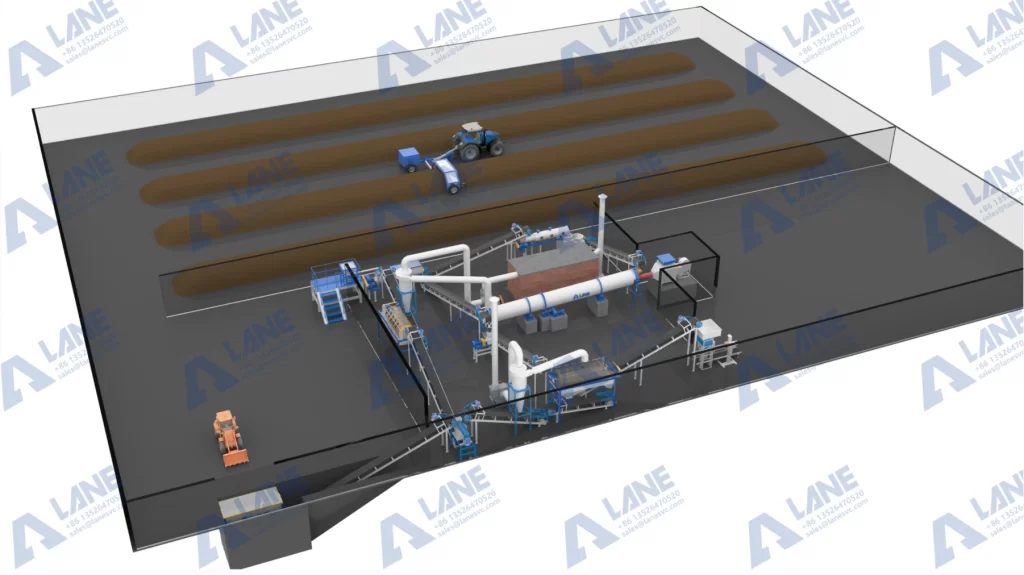
LANE Heavy Industry offers a complete production line tailored for organic fertilizer production from corn stalk. Key equipment includes:
The integration of these machines reduces labor costs, shortens production cycles, and enhances output quality. This makes large-scale production cost-effective.
Organic fertilizer production from corn stalk is not only environmentally sustainable but also profitable. Considerations include:
Depending on scale, you can achieve ROI within 12–24 months. This highlights the economic viability of organic fertilizer production from corn stalk.
Organic fertilizer production from corn stalks addresses multiple environmental concerns:
By transforming corn stalks into valuable fertilizer, farmers and businesses contribute to circular economy initiatives while improving crop yields.
Some challenges in organic fertilizer production from corn stalk include:
LANE Heavy Industry provides technical support and optimized machinery to overcome these production challenges efficiently.
Organic fertilizer production from corn stalk is a sustainable, eco-friendly, and profitable agricultural venture. It represents a win-win opportunity for the environment and agribusiness. With the professional production line from LANE Heavy Industry, the commercial process of organic fertilizer production from corn stalk becomes efficient, stable, and cost-effective. The low cost, high market demand, and environmental benefits make organic fertilizer production from corn stalk a promising industry for investors and farmers.
Q1: Can other crop residues be used along with corn stalks for organic fertilizer?
Yes, combining corn stalks with other residues like wheat straw or rice husks can enhance nutrient content and fermentation efficiency.
Q2: How long does the production cycle take?
The full cycle of organic fertilizer production from corn stalk typically ranges from 20 to 40 days, depending on composting and drying time.
Q3: What is the output capacity of LANE Heavy Industry’s production line?
LANE offers scalable solutions, ranging from 5,000 to 50,000 tons per year, tailored to commercial needs.
Q4: Is organic fertilizer from corn stalk safe for all crops?
Yes, it is completely safe, environmentally friendly, and suitable for vegetables, fruits, grains, and ornamental plants.
Henan Lane Heavy Industry Machinery Technology Co., Ltd.
Email: sales@lanesvc.com
Contact number: +86 13526470520
Whatsapp: +86 13526470520