
When people talk about organic fertilizer, they often focus on raw materials like manure, sludge, or organic waste. But in real production, water content is just as important. This is where the fertilizer dewatering machine for organic fertilizer production plays a key role. Too much water makes later processes difficult, while proper dewatering improves fermentation, granulation, and final fertilizer quality.
In daily operation, different factories face different materials and moisture levels. Because of this, not all dewatering machines work the same way. Their internal structures and working principles directly decide where they can be used. In this article, we look at three common machines: rotary drum dewatering machines, inclined screen dewatering machines, and squeezing dewatering machines, and explain their differences in a simple and clear way.
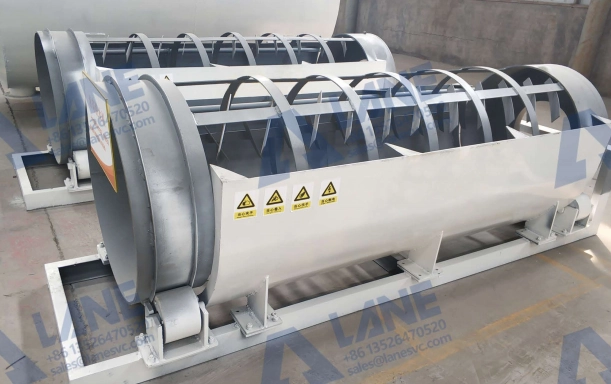
A rotary drum dewatering machine has a rotating cylindrical drum with a screen surface. Material enters the drum and slowly moves forward as the drum rotates. Water passes through the screen under gravity and light centrifugal force, while solid material stays inside.
In organic fertilizer plants, this type of equipment is often used as a fertilizer dewatering machine for organic fertilizer production during the pre-treatment stage. Its biggest advantage is stable operation and simple structure. Because it does not apply strong pressure, it works well with materials that have large particles and good flowability.
However, the dewatering depth is limited. For projects that require very low moisture content, this machine is usually not enough by itself. Still, as a first-step solution, it helps reduce water load for later processes.
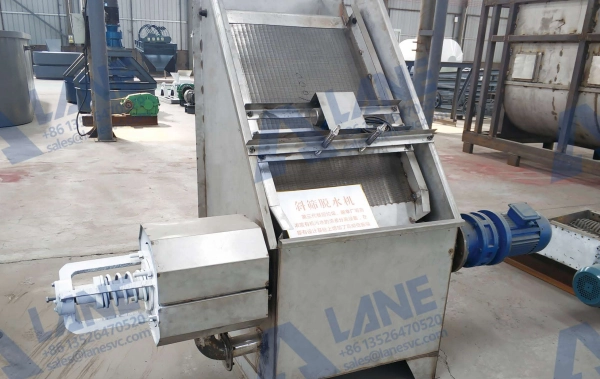
The inclined screen dewatering machine uses a sloped screen surface to separate water from solids. Material flows downward naturally, and liquid drains through narrow gaps in the screen. There are very few moving parts, which makes the design simple and easy to maintain.
As a fertilizer dewatering machine for organic fertilizer production, this equipment is often used when the material is light, fibrous, or has low solid concentration. It mainly relies on gravity, so energy consumption is low and operation is quiet.
Because the dewatering force is gentle, this machine is usually used for preliminary separation rather than final dewatering. In many fertilizer plants, it works together with other machines to form a complete processing system.
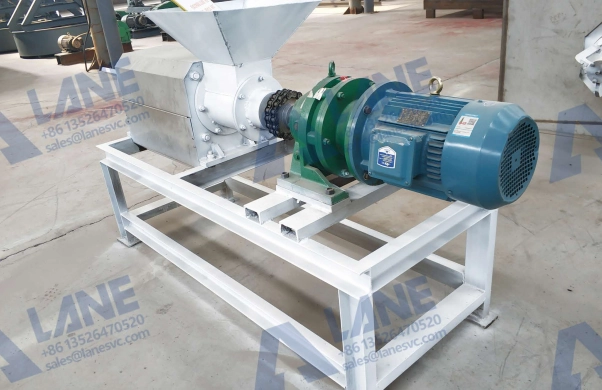
Compared with the previous two machines, screw extrusion dehydrator work in a very different way. Inside the machine, a screw shaft pushes material forward while pressure gradually increases. Water is forced out through a high-strength screen.
This design makes it a powerful fertilizer dewatering machine for organic fertilizer production, especially for manure, sludge, and high-moisture organic waste. The mechanical squeezing action allows much lower final moisture content, which is ideal for fermentation and granulation stages.
The structure is more complex, and the machine requires proper adjustment and maintenance. But for plants aiming at higher efficiency and better product quality, it is often the best choice.
The real difference between these machines comes from how they work inside. Rotary drum and inclined screen machines mainly rely on gravity, so they are suitable for early-stage dewatering. Squeezing machines apply mechanical force, making them suitable for deep dewatering.
Choosing the right fertilizer dewatering machine for organic fertilizer production depends on raw material type, moisture requirements, and production scale. A wrong choice may increase costs and reduce efficiency, while a suitable one can make the whole production line smoother.
This is why understanding structure and working principle is more important than just comparing prices or appearances.
At LANE, we have worked in China’s fertilizer machinery manufacturing field for over 20 years. During this time, we have supplied many types of fertilizer dewatering machine for organic fertilizer production to customers with very different needs. From small farms to large industrial fertilizer plants, we have seen how correct equipment selection changes production results.
We do not only provide single machines. Our professional engineering team designs customized solutions based on raw materials, capacity, and site conditions. From equipment manufacturing to complete fertilizer production line installation, we support our clients step by step.
One major advantage of working with us is customization. Every fertilizer dewatering machine for organic fertilizer production we supply can be adjusted in structure, capacity, and materials to match real operating conditions. We also provide full installation guidance and on-site commissioning to ensure smooth startup.
After installation, our service does not stop. We offer long-term after-sales support, including maintenance advice, troubleshooting, and equipment upgrades. This helps our customers keep stable production and reduce downtime.
Quality is always our priority. Our equipment is manufactured according to ISO9001 quality management standards and meets CE certification requirements. This ensures safety, durability, and stable performance in real production environments.
Besides dewatering equipment, we specialize in complete fertilizer production solutions, including organic fertilizer equipment, compound fertilizer equipment, NPK production lines, and supporting systems. With a complete product range and experienced team, we help customers build efficient and reliable fertilizer plants using the right fertilizer dewatering machine for organic fertilizer production from the very beginning.
In organic fertilizer manufacturing, dewatering is not just a small step—it is a key process that affects the entire organic fertilizer production line. By understanding the differences between rotary drum, inclined screen, and squeezing machines, producers can make smarter decisions. With our experience, customization ability, and full-service support, we are confident in helping clients choose and apply the most suitable fertilizer dewatering machine for organic fertilizer production for long-term success.
For more details, please feel free to contact us.
Henan Lane Heavy Industry Machinery Technology Co., Ltd.
Email: sales@lanesvc.com
Contact number: +86 13526470520
Whatsapp: +86 13526470520