
Transforming distillery by-products into valuable soil nutrients has become one of the most promising trends in modern agriculture. Many producers are now learning how to make vinasse into organic fertilizer not only to reduce waste, but to support more sustainable farming practices. In fact, the interest in ways to make vinasse into organic fertilizer has grown rapidly as farmers search for cost-effective and environmentally friendly solutions. Vinasse, with its rich organic matter, has emerged as a surprisingly powerful resource—once properly processed.
Vinasse, the thick, nutrient-rich residue left after alcohol distillation, was long considered a disposal headache for many factories. Improperly managed, it can pose environmental challenges due to its high biological oxygen demand and acidic nature. But when treated correctly, vinasse can be transformed into a stable, nutrient-balanced fertilizer that enriches soil health, improves crop yield, and supports long-term sustainability. This shift reflects agriculture’s growing interest in circular practices that transform by-products into new resources.
LANE’s Role in the Rise of Vinasse Recycling
Behind this transformation stands a rapidly evolving industry of fertilizer machinery manufacturers. Among these players, LANE has built a reputation for practical solutions that fit real-world needs. For more than two decades, our company has focused on developing equipment that makes organic fertilizer production more efficient and reliable. With an engineering team experienced in full-line design, manufacturing, and installation, we have helped clients establish production lines tailored to their raw materials—vinasse included.
We don’t just provide machines; we offer complete support from installation to maintenance and system upgrades. Our equipment meets ISO 9001 and CE standards, and we specialize in fertilizer production lines, NPK lines, organic fertilizer machines, and compound fertilizer machines. In many projects, helping customers make vinasse into organic fertilizer has become one of the most practical and sustainable solutions.
Step 1: Stabilizing Vinasse Before Processing
Before beginning the full transformation, producers must first stabilize the vinasse. Fresh vinasse contains high moisture levels, so it’s mixed with carbon-rich materials such as rice husk, straw powder, or sawdust. This improves texture and creates an optimal environment for composting microorganisms. It’s the first essential move to successfully make vinasse into organic fertilizer.
Step 2: Aerobic Fermentation—the Heart of the Process
Once blended, the mixture enters the vertical fermentation tank. This is where microbial activity generates heat, kills pathogens, and converts raw vinasse into stable organic matter.
A groove-type compost turner—keeps the material oxygenated and evenly heated. Through years of project experience, we at LANE often help customers select the right fermentation tank to match their scale and climate. Proper fermentation is the foundation for producers who aim to make vinasse into organic fertilizer efficiently.

Step 3: Optional Nutrient Adjustment
After fermentation, the compost becomes more stable. Some producers choose to adjust nutrient levels by adding nitrogen sources or mineral additives. This tailoring helps meet market-specific requirements and enhances the final fertilizer’s commercial value.
Step 4: Granulation for Better Market Appeal
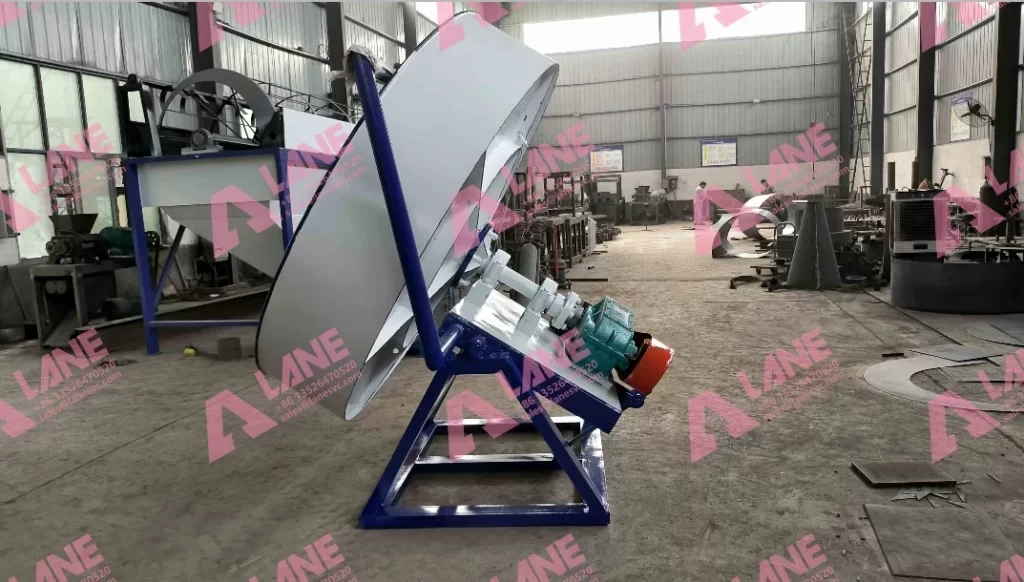
Granulation is a key part of making organic fertilizer easy to transport, sell, and apply. To make vinasse into organic fertilizer that is competitive in the market, producers need uniform, durable pellets.
LANE offers several granulator types—disc granulators, rotary drum granulators, and stirring pin granulators—each designed to handle materials like vinasse, which can sometimes be sticky or uneven. The choice depends on the customer’s capacity and preferred particle size.
Step 5: Drying, Cooling, and Screening
Next, the freshly formed granules enter the drying process. The rotary drum dryer reduces moisture, ensuring long-term storage stability. Cooler follows, then screening removes oversized or undersized particles. Properly dried and screened granules have strong market competitiveness and long shelf life.
Step 6: Packaging and Market Distribution
With all steps completed, the fertilizer is ready for packaging. Vinasse-based organic fertilizer improves soil structure, enhances microbial diversity, and boosts water retention. These benefits are among the main reasons producers want to make vinasse into organic fertilizer in the first place.
As more facilities switch to vinasse recycling, common questions arise:
These are the types of issues we help clients solve daily. At LANE, we design each system based on raw materials, production goals, and site conditions. Every project is treated as a partnership.
Small producers often worry about investment costs. But in reality, many vinasse fertilizer lines start small and expand later. We frequently design compact systems for smaller operations wanting to make vinasse into organic fertilizer effectively.
Large facilities, meanwhile, usually require fully automated continuous lines. Automation ensures consistent quality and reduces labor costs. Our team has installed such systems in multiple countries, showing how scalable vinasse processing can be.
Today’s agriculture is moving toward resource recycling and carbon reduction. Distillery waste recycling fits perfectly within this trend. Turning by-products into fertilizer helps reduce environmental pressure and create new revenue streams. For many distilleries, choosing to make vinasse into organic fertilizer is both environmentally responsible and economically smart.
Our partnership with customers doesn’t end at installation. We assist with maintenance, troubleshooting, spare parts, process upgrades, and energy-efficiency improvements. Ensuring stable long-term operation is a core part of our company’s philosophy.
Around the world, demand for organic fertilizer continues to grow. Farmers increasingly prefer fertilizers that improve soil health without harmful residues. Vinasse-based organic fertilizers deliver these benefits naturally. Clients who make vinasse into organic fertilizer often find the market surprisingly receptive.
Each raw material behaves differently. Some producers face difficulties in fermentation or granulation during the early stages. Our engineering team helps them overcome these challenges through formula adjustments, equipment tuning, and process optimization. Experience matters, especially when handling unique materials like vinasse.
With global interest in sustainable agriculture rising, vinasse recycling is set to become even more widespread. Choosing to make vinasse into organic fertilizer aligns perfectly with environmental policy, market demand, and the global shift toward circular resource use.
Ultimately, the choice to make vinasse into organic fertilizer represents a broader commitment to resource efficiency and long-term soil health. This transformation benefits producers, farmers, and the environment alike. At LANE, we remain dedicated to helping partners around the world turn vinasse into a valuable agricultural asset—one production line at a time.
For more details, please feel free to contact us.
Henan Lane Heavy Industry Machinery Technology Co., Ltd.
Email: sales@lanesvc.com
Contact number: +86 13526470520
Whatsapp: +86 13526470520