
Table of Contents
The agricultural sector is leaning toward sustainable fertilizer as a nutrient source for their crops, creating a boom in the fertilizer industry. Farmers and agribusinesses are now creating their own fertilizers. Establishing an organic fertilizer production plant is an economic and environmentally conscious decision.
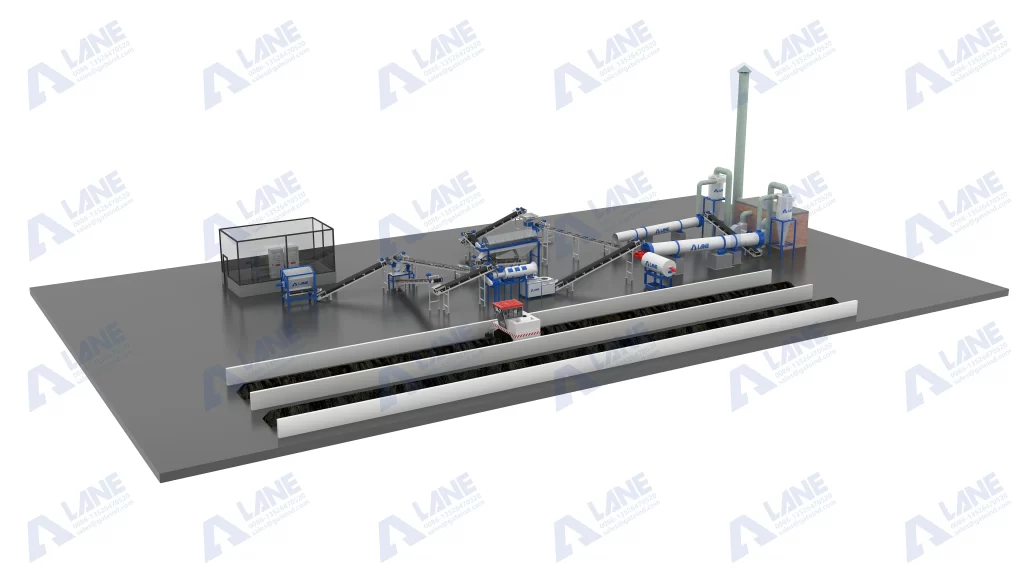
However, the success of such a plant often depends on an underestimated factor: the organic fertilizer plant layout. The organic fertilizer plant layout is not merely a matter of arranging equipment and facilities. It is the backbone of production efficiency, output quality, and operational safety. An unreasonable layout leads to transportation problems, chaotic production processes, low equipment utilization, and safety hazards.
Partnering with LANE Heavy Industry, an industry leader in the fertilizer industry, will help you transform complex production line challenges into a streamlined process, reduce energy consumption, improve labor productivity, and lay a solid foundation for future scaling.
An optimal, high-performing organic fertilizer plant layout is built on several engineering principles.
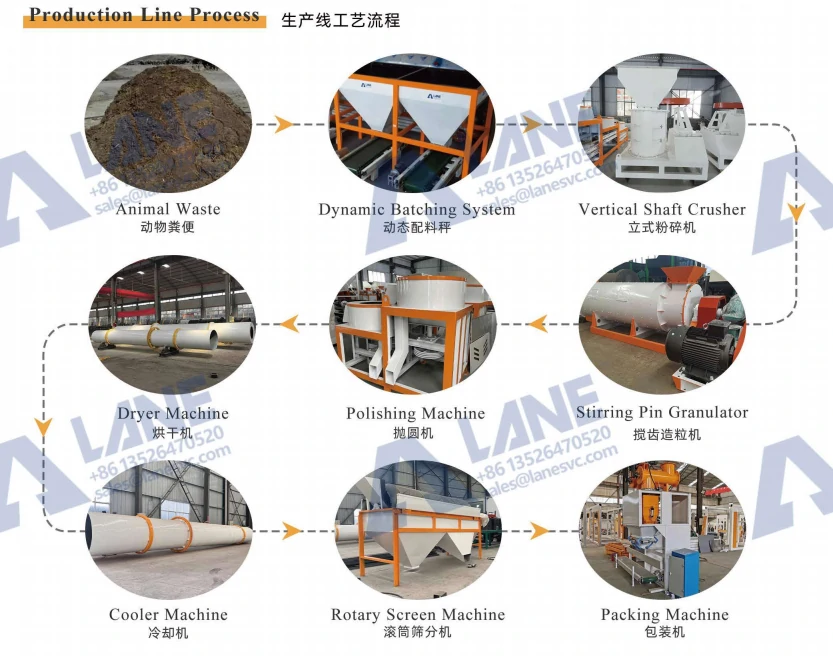
Many first-time plant owners try to save money and fall into traps that undermine efficiency:
At LANE Heavy Industry, we believe the organic fertilizer plant layout is one of the most important aspects of an organic fertilizer production line. Our layout integrates all aspects of the project:
A well-designed organic fertilizer plant layout typically organizes into five key zones:
| Zone | Primary Function | Key Considerations in Layout |
| 1. Raw Material Reception & Pre-processing | Receiving, sorting, and initial sizing of feedstock (manure, biomass, etc.). | Adequate truck maneuvering space, covered storage pits or bunkers, direct access to shredding/crushing equipment. |
| 2. Active Fermentation & Curing | Controlled bio-decomposition (composting). | Area is large. Layout must allow for turning equipment access, aeration systems, and logical movement from fresh to cured piles. Proper windrow orientation. |
| 3. Refining & Production | Crushing, screening, mixing with additives, granulation. | The heart of the line. Layout must ensure smooth flow via conveyors. High ceilings for equipment, dedicated space for dust collection systems. |
| 4. Post-Processing & Storage | Drying, cooling, coating, and bulk storage of finished product. | Requires efficient thermal and air flow management. Layout must connect dryers/coolers to storage silos or bins with minimal transfer points. |
| 5. Packaging, Loading & Utilities | Bagging, palletizing, and dispatch. Housing of electrical, control rooms. | Separate from raw zones to ensure cleanliness. Direct access to loading bays. Utilities placed centrally to reduce power/pipe runs. |
Your organic fertilizer plant layout represents your business logic. A scientific and optimized layout not only improves production efficiency and increases output but also reduces costs. LANE’s plant design ensures safety and lays a solid foundation for the development of the plant.
Investing in a scientifically optimized, professionally engineered design is not an extra cost. It helps you with profitability, product integrity, and long-term resilience. By partnering with LANE Heavy Industry, you gain a production system designed for maximum efficiency and output from the ground up.
Q1: How much does a professional organic fertilizer plant layout design cost?
A1: The costs of layout design varies based on plant scale and complexity. At LANE Heavy Industry, We ask for a small fees which is typically integrated into our turnkey project proposal. The investment is quickly recouped through reduced operational costs, higher output, and avoidance of expensive retrofits.
Q2: Can you design a layout for my existing building, or do I need a new structure?
A2: We excel at both. We can conduct a site survey of your existing building and propose an optimal layout within the available area. We can identify improvements for an old factory. For a new building, we provide complete, full design service for efficient results.
Q3: How long does the layout and plant commissioning process take?
A3: For a mid-scale turnkey project, the timeline is typically 3 months for detailed design, manufacturing, layout planning, and shipping, followed by 2-3 months for installation and commissioning. A clear, optimized layout reduces installation time and confusion.
Q4: Does the layout differ greatly for different types of organic fertilizer (e.g., powder vs. pellets)?
A4: Yes. A powder production line layout emphasizes mixing and screening zones. A granulation line requires dedicated space for granulation, drying, cooling, and coating equipment.
Q5: How does LANE Heavy Industry ensure the layout meets local environmental and safety regulations?
A5: Our designs incorporate international best practices for environmental control (dust, odor, water management) and safety (fire exits, equipment guarding, clear signage). We also provide documentation and training to help you comply with local regulations.
For more details, please feel free to contact us.
Henan Lane Heavy Industry Machinery Technology Co., Ltd.
Email: sales@lanesvc.com
Contact number: +86 13526470520
Whatsapp: +86 13526470520