Key Considerations for Designing an Organic Fertilizer Production Line for Garlic
Introduction: Why Garlic Demands a Specialized Approach
Garlic is a high-value cash crop with strict soil fertility and nutrient demands. To achieve optimal bulb size, flavor intensity, and natural disease resistance, it requires a rich soil ecosystem with balanced nutrients. A generic, one-size-fits-all fertilizer might fail to deliver the precise nutrient solution for garlic. For commercial growers and entrepreneurial fertilizer producers, investing in a dedicated Organic Fertilizer Production Line for Garlic is a strategic decision which helps you capture a premium market and build a competitive advantage.
LANE Heavy Industry, a leader in the fertilizer production machinery industry, has created a scientific and efficient organic fertilizer production line for garlic. Our R&D, production, and after-sales service provide reliable equipment support for your business. This article outlines the five critical considerations for designing an effective, efficient, and profitable organic fertilizer production line for garlic.
Consideration #1: Recipe & Raw Material Handling
The first step of the journey starts with the proper formula of the organic fertilizer. It is essential for the selection of the raw materials.
- Nutrient Targeting: Garlic benefits from sulfur content for its characteristic compounds. For root and bulb development, it needs phosphorus and balanced potassium for overall plant health. Your base recipe should incorporate materials like:
- Animal Manures: Poultry, sheep manure for concentrated nitrogen and minerals.
- Plant-Based Meals: Alfalfa, kelp for micronutrients, growth hormones, and slow-release nitrogen.
- Mineral Additives: Gypsum for sulfur and calcium, rock phosphate for phosphorus.
- Carbon-to-Nitrogen (C:N) Balance: Achieving an optimal C:N ratio of 25-30:1 is most critical for efficient composting. This requires careful proportioning of nitrogen-rich materials with carbon-rich materials like straw, sawdust, or rice husks.
- Pre-Processing Equipment: A LANE semi-wet material crusher is effective for this stage. It can effectively crush fresh, high-moisture raw materials like vegetable waste or manure cakes and simultaneously crush drier substances like straw, ensuring a homogeneous mix that accelerates subsequent fermentation.
Consideration #2: Optimizing the Fermentation Core
The fermentation process determines the nutrient quality of your production line. In this process, raw materials are stabilized, pathogens are destroyed, and beneficial microbes are cultivated.
- Choosing the Right Method: For a dedicated organic fertilizer production line for garlic, two primary methods exist:
- Windrow Composting: This is ideal for large-scale continuous production. A LANE Hydraulic Crawler Compost Turner is best for this situation. Its robust design can handle large windrows. This machine can do deep turning and aeration. It is equipped with a water spray system for odor and temperature control. This machine ensures uniform temperature (55-70°C) necessary to eliminate weeds and pathogens.
- In-Vessel Fermentation: This offers greater control and a faster fermentation cycle to create premium quality organic fertilizer. LANE’s Fermentation Tank System uses aeration and mechanical agitation to create ideal conditions for fermentation and produces a highly consistent mature compost.
- The Curing Stage:After the active fermentation, a 2-4 week curing period is non-negotiable. This allows for microbial succession, stabilization of pH, and the development of stable humus.
Consideration #3: Granulation Selection for Soil Application
The physical form of the fertilizer determines shelf life, application efficiency, and nutrient release pattern in the field. For any professional Organic Fertilizer Production Line for Garlic, granulation is not an option—it is a necessity.
- The Granulation Imperative: Powdered compost is difficult to store, transport, and apply. Granulation creates a dense, uniform, dust-free product.
- Machine Choice Dictates Product:
- Disc Granulator: This is best for budget production. This line uses a wet process. It allows for precise adjustment of granular size (ideal for setting 3-4mm granules perfect for garlic) and is excellent for formulations that include adhesive powders like bentonite.
- Stirring Pin Granulator: This is LANE’s recommended choice for 100% organic materials. This machine uses pins to create a wind cyclone and friction to create perfectly shaped, high-density granules.
- Rotary Drum Granulator: This granulator is suitable for large-scale volume production where slightly less uniform granule shape is acceptable. It operates on a similar principle to the disc granulator but with a mechanical action.
Consideration #4: Drying, Cooling, and Final Processing
After granulation, it is essential to manage moisture to ensure product stability and quality. In a professional Organic Fertilizer Production Line for Garlic, proper drying, cooling, and screening directly determine shelf life and market acceptance.
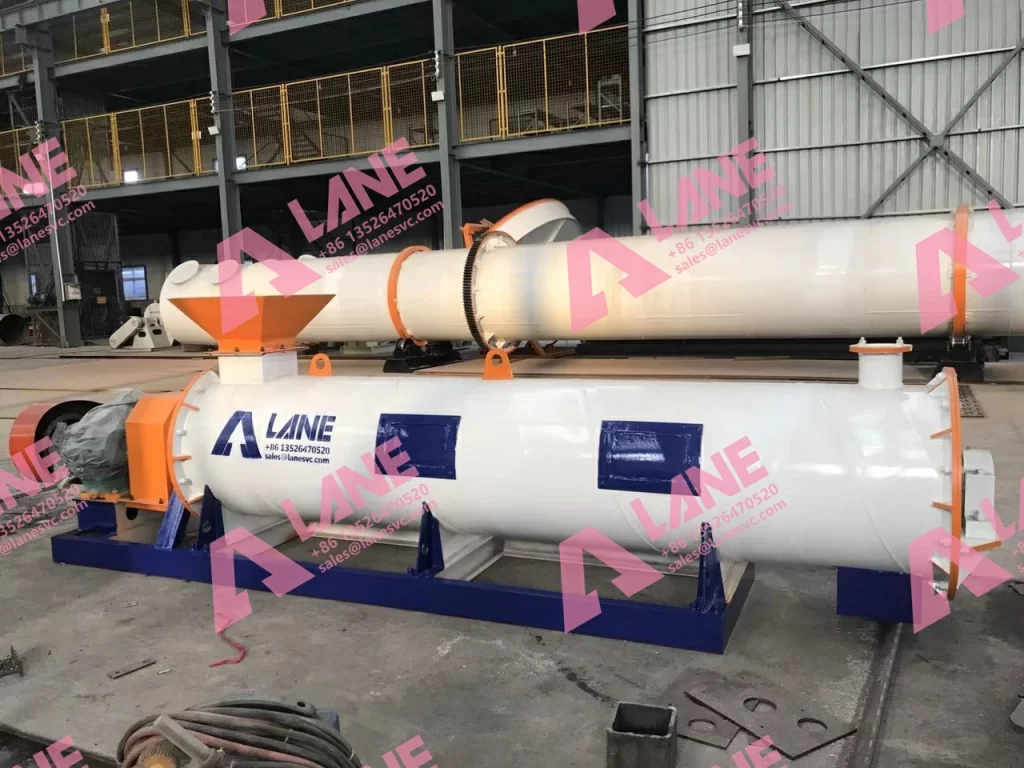
- Drying: Freshly made granules contain 15-20% moisture. This must be reduced below 10% to prevent caking and microbial spoilage during storage. A LANE Rotary Dryer uses counter-flow heating in a controlled, rotating drum to gently and uniformly reduce moisture without “baking” and killing beneficial microbes.
- Cooling: Hot granules are soft and fragile. A Rotary Cooler uses ambient air to lower the temperature of the granules. This hardens them and prepares them for screening and coating.
- Screening & Coating: In this stage, a Rotary Screening Machine separates on-size granules from fines and oversized granules. They are sent to the crusher and re-enter the granulation process. An optional Coating Drum can then apply additives to prevent caking and dust.
Consideration #5: Scalability and Automation Philosophy
Your production line should have the option for scaling.
- Modular Design:For a scalable Organic Fertilizer Production Line for Garlic, LANE designs systems that are engineered with modularity. You can begin with a core setup including a crusher, fermenter, and granulator. Then, as your business grows, you can add modules such as automatic batching units, packaging systems, or more advanced drying lines as market demand increases.
- Automation Level: This determines the right balance between labor and capital.
- Basic Line: Relies on discrete units with manual material transfer between stages.
- Semi-Automatic Line: Uses belt conveyors and bucket elevators for material handling, with manual control points.
- Fully Automatic Line: This line incorporates PLC control systems, automated weighing and batching, and robotic palletizing. This maximizes output and consistency while minimizing labor costs.
Conclusion: Partnering for Success
Designing an Organic Fertilizer Production Line for Garlic requires careful consideration of garlic’s nutrient needs, process optimization, equipment selection, environmental protection, and cost control. You will need the right equipment partner like LANE Heavy Industry, who can support you with purpose-built machinery and solid engineering expertise for your Organic Fertilizer Production Line for Garlic. With our production line solutions, investors can build fertilizer products that truly match market demand and garlic growth characteristics.
Frequently Asked Questions (FAQ) – Organic Fertilizer Production Line for Garlic
Q1: What is the approximate investment range for a small to medium-scale garlic fertilizer line?
A1: Investment varies significantly based on capacity, automation level, and raw material pre-processing needs. A basic, semi-automatic Organic Fertilizer Production Line for Garlic with an annual output of 10,000–20,000 tons typically requires an investment in the range of $80,000–$200,000 for core equipment. LANE provides detailed quotations based on your specific project assessment.
Q2: Can I produce both powdered and granular fertilizer with the same line?
A2: A2: Yes, a well-designed Organic Fertilizer Production Line for Garlic is highly flexible. After fermentation and crushing, you can divert part of the fine material directly to packaging as premium powdered compost, while the rest proceeds to the granulation section. This allows you to serve different market segments with one production system.
Q3: How do you ensure the final product is truly “organic” and safe for my garlic crop?
A3: Safety is ensured mainly in the fermentation stage. Maintaining a sustained temperature above 55°C (131°F) for a minimum of 15 days during composting is a recognized organic standard for pathogen reduction. LANE’s efficient compost turners and fermentation tanks are specifically designed to achieve and maintain these critical temperatures uniformly throughout the material mass, ensuring your Organic Fertilizer Production Line for Garlic meets organic standards.
Q4: What is the typical power consumption for such a production line?
A4: Power consumption is dominated by the crusher, granulator, and dryer. For a 1-ton-per-hour output line, total connected power might range from 75-150 kW, depending on configuration. LANE engineers focus on energy-efficient motor selection and process flow to minimize operational costs per ton of output.
Q5: Does LANE offer testing services for our local raw materials?
A5: While we are equipment engineers, we strongly recommend and can guide you to partner with local agricultural laboratories for raw material analysis. Based on the nutrient profiles they provide, our process experts can advise on optimal mixing ratios and production parameters for your organic fertilizer production line for garlic.
For more details, please feel free to contact us.
Henan Lane Heavy Industry Machinery Technology Co., Ltd.
Email: sales@lanesvc.com
Contact number: +86 13526470520
Whatsapp: +86 13526470520