
Creating high-quality fertilizer from organic waste has become a key solution to address waste pollution. It not only provides high-quality nutrients to crops but also helps us clean up the environment. The UN is pushing this sustainable solution to governments all over the world. The organic fertilizer production process flow is a sophisticated, multi-stage system that converts livestock manure, crop residues, and food waste into nutrient-rich, soil-amending fertilizers.
Organic fertilizer is created from natural materials such as livestock manure, crop straw, and food waste. It enriches the soil with essential nutrients. It helps us enhance our soil structure and reduce our reliance on chemical fertilizers. The organic fertilizer production process flow requires professional machinery to ensure efficiency, safety, and product quality. LANE Heavy Industry, a leading manufacturer of agricultural machinery, has developed a production line tailored for organic fertilizer production.
An organic fertilizer plant works systematically with rhythmic progression. The organic fertilizer production process flow begins with raw waste and ends with a marketable product. The key stages are:
Every stage in the organic fertilizer production process flow is dependent on the other.
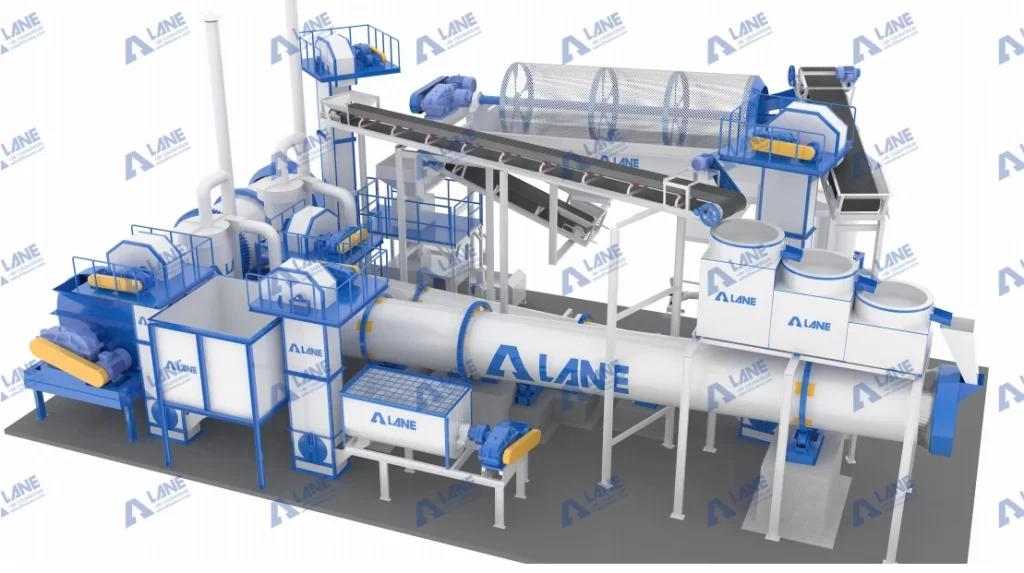
Stage 1: Raw Material Collection & Pre-processing
The first stage of organic fertilizer production is gathering the raw materials. You have to gather carbon-rich (e.g., straw, sawdust) and nitrogen-rich (e.g., manure, sludge) materials to create an optimal Carbon-to-Nitrogen (C:N) ratio, typically 25-30:1. LANE Heavy Industry offers Solid-Liquid Separators and Crushers/Mixers that pre-process these materials. Separators reduce excess moisture from manure, while crushers break down bulky stalks or clumps. This helps create a homogeneous mixture.
Stage 2: Fermentation & Composting (The Heart of the Process)
In this stage, organic waste is transformed into high-quality base compost. First, pre-processed materials are formed into windrows (long piles) or sent to a fermentation tank. They go through controlled aerobic fermentation. In this process, microorganisms break down organic matter and the heat generated from that process kills pathogens and weed seeds.
Turning and aerating the piles is essential to maintain temperature and oxygen levels. The LANE crawler compost turner or fermentation tank is built efficiently to turn and mix the piles. This ensures uniform fermentation.
Stage 3: Crushing, Mixing, and Formulation
After fermentation and curing, the compost is ready to enter the production stage. The base compost is sent to the LANE feeding system where it also acts as temporary storage. It is first sent to the crusher. Compost clumps must be finely crushed to create uniform granules. It is then moved to the mixing stage where the operator can add formulations. The operator can add additives like beneficial microbes, phosphorus, potassium, or other organic amendments to create a custom fertilizer formula.
LANE’s Vertical Crusher and Horizontal Mixer are critical here. The crusher ensures a fine, uniform powder, while the mixer guarantees a perfectly homogenous blend.
Stage 4: Granulation – Creating the Final Product Form
In the granulation process, the granulator converts the fine powder into durable, uniform granules that are easy to store, transport, spread, and sell. This increases the price of the organic fertilizer. LANE Heavy Industry provides several advanced granulation options.
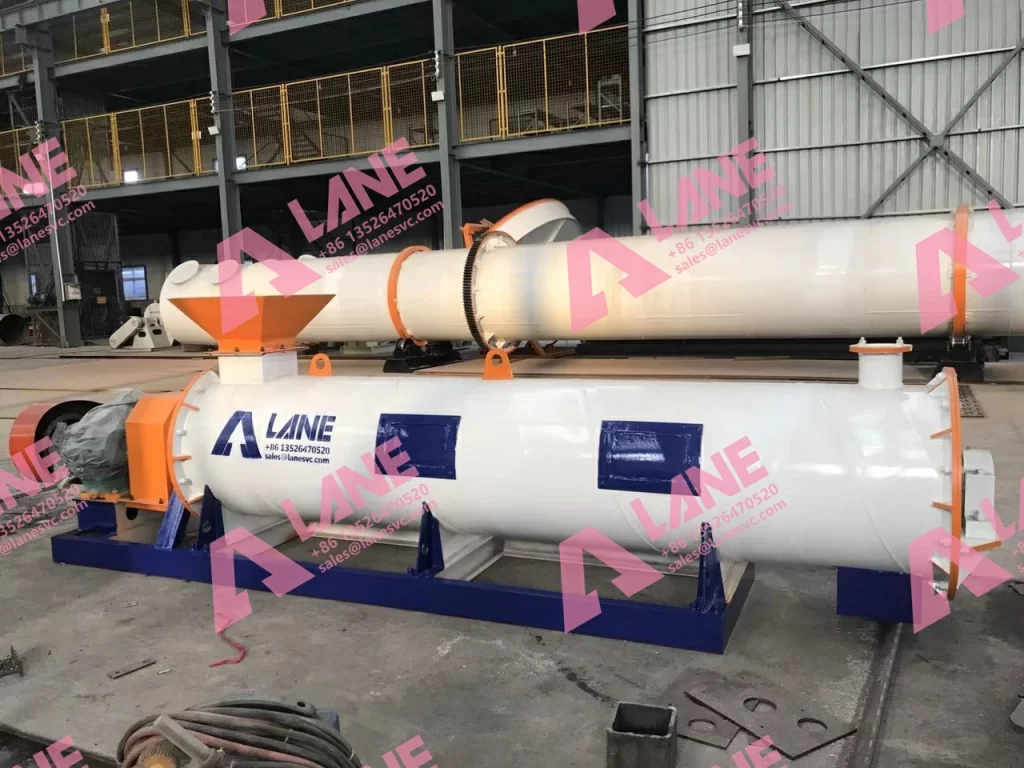
Stage 5: Drying, Cooling, and Screening
Freshly made pellets have high moisture content and are soft. LANE rotary drum dryers and coolers are used to bring down the moisture content and optimize the temperature to prevent them from caking. It also acts as a second granulator.
The granules are then sent to the Rotary Screening Drum. This machine separates on-size pellets from undersized fines and sends them back to the crusher to be recycled. The on-size granules are sent to the next stage.
Stage 6: Coating and Packaging
To improve appearance and prevent caking, on-spec granules can be coated in a coating machine. Then the final finished organic fertilizer is conveyed to automated weighing and packaging systems for bagging. They are now ready for distribution.
The efficiency, output, and profitability of the organic fertilizer production process flow depend on reliable equipment. LANE Heavy Industry stands out by offering:
The organic fertilizer production process flow is a systematic project that converts organic waste into valuable agricultural fertilizer. It is a manageable, highly rewarding venture that also has environmental benefits. Unlocking this “waste-to-wealth” potential requires an expert partner. LANE Heavy Industry’s full set of organic fertilizer production equipment, with its high efficiency, stability, and flexibility, provides a reliable solution for organic fertilizer production.
Q1: What is the most time-consuming part of the organic fertilizer production process flow?
A:The fermentation and composting stage is typically the longest, taking anywhere from 15 to 30 days. However, using efficient equipment like LANE’s Compost Turner can significantly accelerate this process by ensuring optimal aeration and temperature control.
Q2: Can I produce both powder and granular organic fertilizer with one line?
A: Yes. A complete granular production line can also produce powder fertilizer. The process simply diverges after the mixing stage; the powder can be directly packaged instead of being sent to the granulation, drying, and cooling units.
Q3: How do I choose the right granulator for my materials?
A: The choice depends on your raw material characteristics (humidity, fiber content) and desired production scale. LANE Heavy Industry experts can advise on the best option—whether it’s the New Type Organic Granulator for pure organics, the Drum Granulator for large volume, or the Flat Die Mill for flexibility.
Q4: Is the production process environmentally friendly?
A: Absolutely. A well-designed, closed-loop process controls dust and odor. The core fermentation process eliminates harmful pathogens and reduces methane emissions (compared to landfilling waste). It is the epitome of an eco-friendly solution.
Q5: Why is reliable machinery so important for this business?
A: Organic fertilizer production is a continuous material-handling process. A breakdown in one machine, like the crusher, dryer, or granulator, can halt the entire organic fertilizer production process flow, leading to spoilage, downtime, and lost revenue. Investing in durable, reliable equipment from the start, like that from LANE, minimizes this risk and protects your investment.
For more details, please feel free to contact us.
Henan Lane Heavy Industry Machinery Technology Co., Ltd.
Email: sales@lanesvc.com
Contact number: +86 13526470520
Whatsapp: +86 13526470520