
Turning using coffee grounds as organic fertilizer into a profitable, efficient, and scalable process depends on one decisive factor: granulation. Coffee grounds are rich in nitrogen and beloved by organic farmers, but loose powder has low density, inconsistent nutrient release, and poor storage stability. Granulation solves these problems—if you choose the right machine.
This article explores how coffee grounds are transformed into high-value fertilizer granules, what type of granulator fits different capacity and shape demands, how each internal structure influences granule quality, and why Lane—a professional manufacturer of fertilizer machinery in China—has become a trusted global supplier. Throughout the discussion, we return repeatedly to our guiding keyword “using coffee grounds as organic fertilizer” to understand how machinery selection makes or breaks the process.
Before diving into equipment choices, it’s worth asking: why granulate at all when using coffee grounds as organic fertilizer?
Coffee grounds naturally contain nitrogen, lignin, and trace minerals, but in loose form they cause several production problems:
Poor Flowability – Powdered coffee grounds clog conveyors and feeders.
Uneven Particle Size – Inconsistent application leads to nutrient imbalance in soil.
Low Bulk Density – Storage and transport become costly.
Dust Generation – Creates workplace hazards and product quality issues.
Slow or Inconsistent Decomposition – Granules improve microbial activity and release rate.
Granulation reshapes these fine particles into stable, uniformly sized granules that resist moisture, enhance nutrient release, and improve handling. Therefore, anyone interested in using coffee grounds as organic fertilizer at a commercial scale quickly discovers the importance of the right granulator.
The journey from café waste to agricultural gold involves a sequence of mechanical and biological steps. While processes vary by plant size, the core steps remain the same:
1.Pretreatment
Before using coffee grounds as organic fertilizer, moisture content must be controlled. Fresh grounds typically contain 55–65% moisture. For most granulation methods, ideal moisture is 25–40%.
Pretreatment includes:
drying or partial drying
crushing to even particle size
mixing with additives (nutrients, composted manure, or beneficial microbes)
2.Composting (Optional but Recommended)
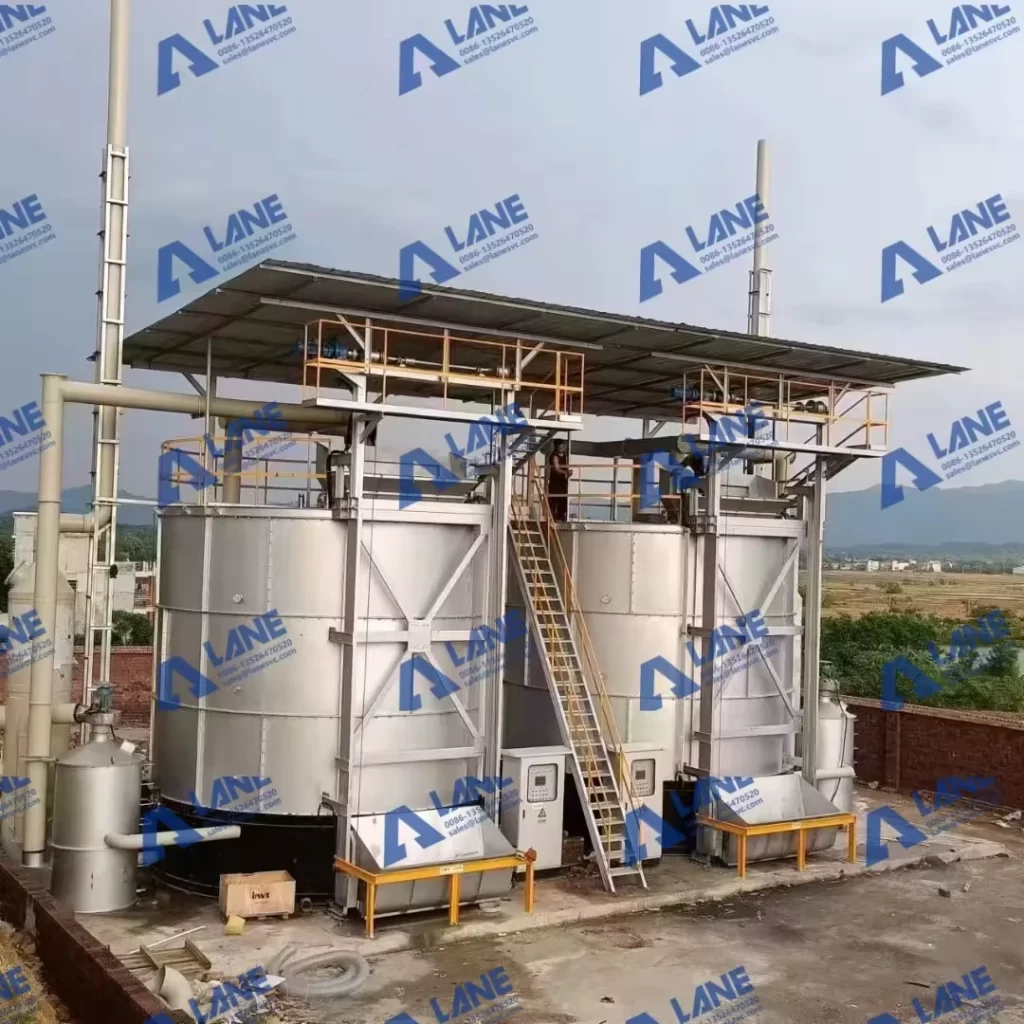
Vertical fermentation tank stabilizes the material, reduces pathogens, and improves granulation behavior. Aerated static piles or fermentation tanks can be used.
3.Granulation
The heart of the process. Different granulators—disc, rotary drum, flat die, ring die, or extrusion types—shape the prepared material into spherical or cylindrical granules.
4.Drying & Cooling
Granules are dried to below 10% moisture to improve storage life.
Oversize granules are crushed; undersize ones are re-granulated.
6.Packaging
Finished granules are ready for transport or retail markets.
Each step impacts final product performance, highlighting why choosing suitable machinery is central to the success of using coffee grounds as organic fertilizer.
This question has no universal answer—it depends entirely on your desired output capacity, granule shape, and investment plan. Let’s break down the major equipment types used when using coffee grounds as organic fertilizer.
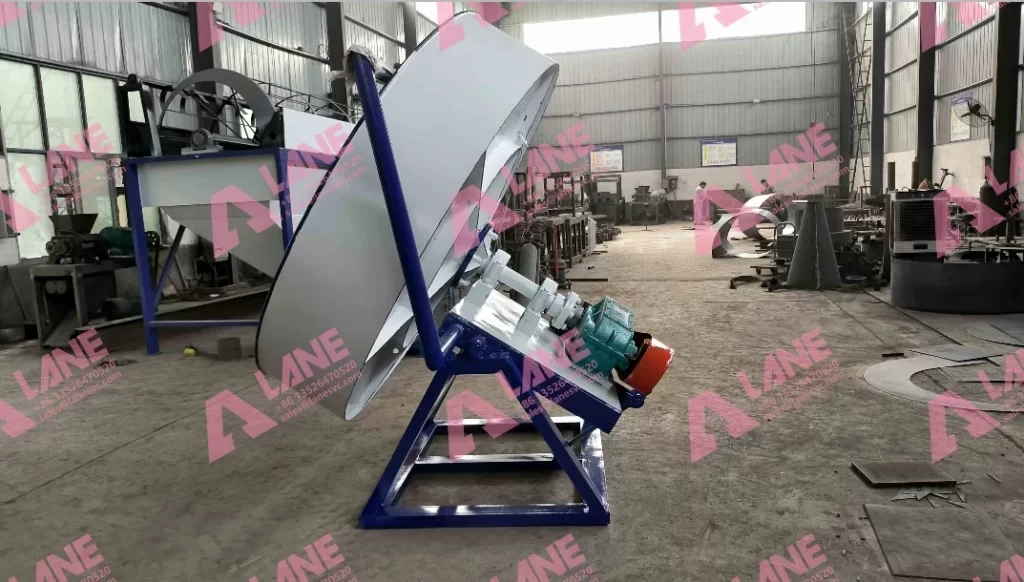
1.Disc Granulator: Is It Ideal for Small to Medium Coffee-Ground Fertilizer Production?
The disc or pan granulator uses a rotating inclined plate to roll materials into spherical granules.
Strengths
Adjustable granule size (3–8 mm)
Excellent for medium hardness materials like coffee grounds
Simple structure, low cost
Easy to maintain
High granulation rate (85–95%)
Limitations
Moderate output (0.5–6 tons per hour)
Not ideal for very large industrial lines
Requires stable moisture control
When to Choose It
If your production capacity is moderate and your product requires round granules, the disc granulator excels at using coffee grounds as organic fertilizer efficiently and cost-effectively.
2.Rotary Drum Granulator: Is It the Best Choice for Large-Scale Coffee Ground Fertilizer Plants?
The rotary drum granulator is the workhorse for large fertilizer factories.
Strengths
High capacity (5–30+ tons per hour)
Continuous and stable granulation
Suitable for compound fertilizers mixed with coffee grounds
Excellent for large-scale production lines
Limitations
Higher initial investment
Larger footprint
When to Choose It
If you aim for industrial-scale using coffee grounds as organic fertilizer, especially when mixing with NPK or other nutrients, the rotary drum granulator is the best solution.
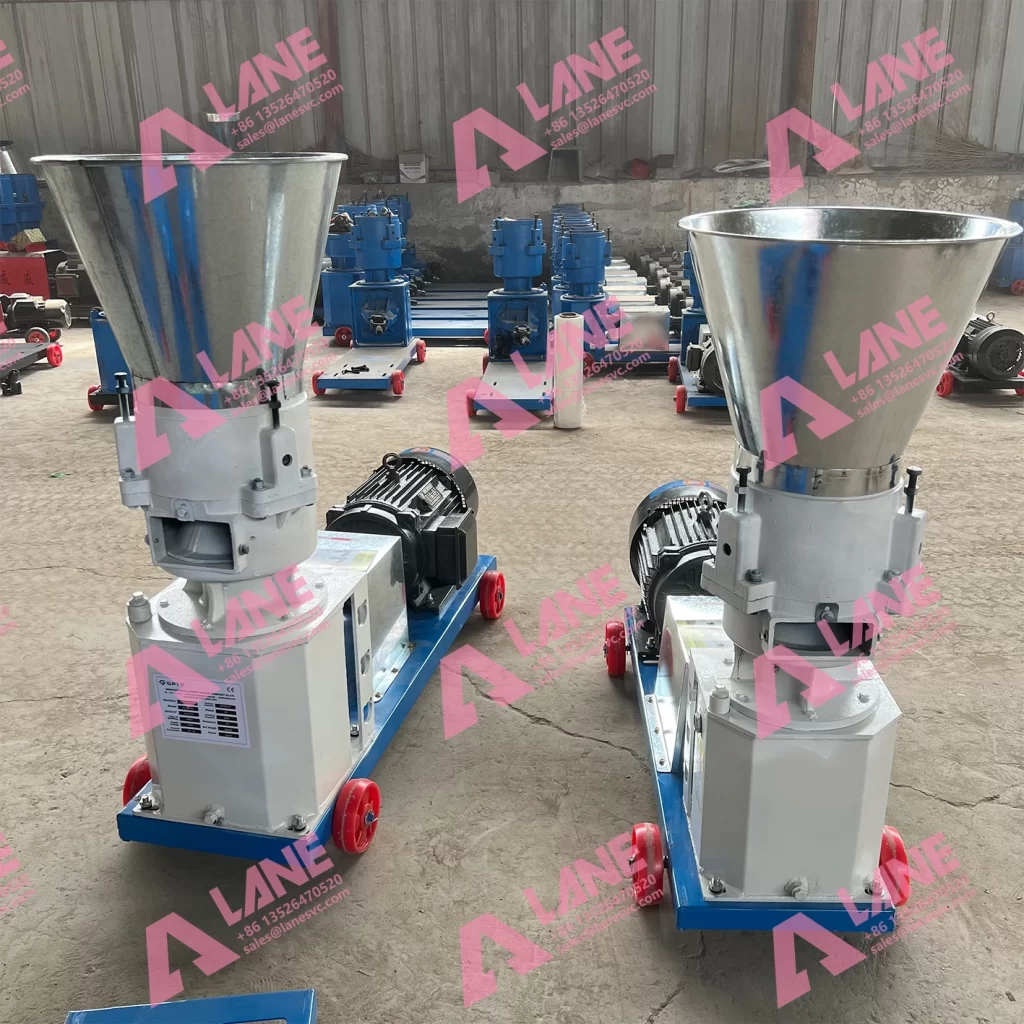
3.Flat Die Granulator: Can It Produce Densely Packed Coffee Ground Pellets?
Flat die granulators compress material through a flat mold, forming cylindrical pellets.
Strengths
Perfect for high-fiber materials like coffee grounds
Produces dense, long-lasting pellets
Lower temperature process preserves microbial inoculants
Suitable for organic fertilizer standards
Limitations
Pellet shape is cylindrical, not spherical
Output capacity moderate
When to Choose It
If your business model includes bio-organic fertilizer pellets, the flat die granulator works extremely well for using coffee grounds as organic fertilizer in pellet form.
4.Ring Die Granulator: Does It Fit High-Hardness Coffee Ground Pellets?
The vertical ring die granulator offers even higher density and productivity than the flat die version.
Strengths
High compression ratio
Durable pellets with perfect hardness
Lower power consumption per ton compared to flat die
Ideal for large pellet production lines
Limitations
Higher cost
Requires more skilled operation
When to Choose It
When you plan to produce premium high-density pellets for export markets, the ring die granulator is a powerful choice for using coffee grounds as organic fertilizer.
Choosing the right granulator depends on two critical variables:
1.Production Capacity
Small plants (0.5–3 T/H) → Disc granulator or flat die machine
Medium (3–10 T/H) → Disc granulator or ring die machine
Large (10–30+ T/H) → Rotary drum granulator
Coffee grounds behave beautifully in all these machines, but the operational cost per ton decreases significantly as capacity increases.
2.Desired Granule Shape
Spherical (garden fertilizer, retail bags) → Disc or drum granulator
Cylindrical (pelletized organic fertilizer) → Flat die or ring die
Irregular bio-granules (microbial fertilizers) → Flat die
Understanding these variables makes machinery selection far more precise when using coffee grounds as organic fertilizer.
Granulators aren’t just metal shells; their internal components directly influence granule quality. Here’s how major structures impact the process:
Disc Granulator Structure
Disc Plate – Adjustable angle controls granule size
Scraper System – Prevents material buildup
Reducer & Motor – Controls rotational speed
Spray System – Moisture distribution for uniform granulation
Perfect for spherical granules when using coffee grounds as organic fertilizer.
Rotary Drum Granulator Structure
Internal Lining (rubber or acid-resistant steel) – Prevents sticking
Steam/Ammonia Injection Ports – Enhance granulation for compound fertilizers
Large Cylinder – Allows high throughput
Drive Gear System – Ensures stable rotation
Essential for high output and stable quality.
Flat Die Granulator Structure
Flat Die Plate – Determines pellet diameter
Rollers – Compress materials with controlled pressure
Cutter Knife – Adjusts pellet length
This structure creates uniform pellet size even when using coffee grounds as organic fertilizer with added fibers.
Ring Die Granulator Structure
Ring Die – High compression zone for dense pellets
Multiple Rollers – Provide continuous pressing force
Variable Speed Feeder – Ensures consistent input
A top-tier choice for high-density pellets.
Many suppliers offer fertilizer machinery—but few have Lane’s combination of experience, certification, and service. Here is why Lane stands out:
20+ Years of Specialty in Fertilizer Machinery
Lane has focused exclusively on fertilizer production technology for more than two decades. This ensures deep engineering experience specifically suited for using coffee grounds as organic fertilizer manufacturing.
Professional Engineering Team
Lane designs entire fertilizer production lines—customized to moisture content, granule shape, capacity, and raw materials.
Complete Production Line Solutions
Including:
organic fertilizer machines
NPK production lines
compound fertilizer production lines
Global Quality Standards
All machines comply with ISO 9001 and CE certifications, ensuring safety and reliability.
Full After-Sales Support
Lane offers installation, troubleshooting, maintenance, and upgrade services to ensure your plant operates smoothly.
Ability to Tailor Machines for Coffee Ground Materials
Our engineers understand the unique texture, moisture, and compression characteristics of coffee grounds.
For any business aiming to maximize the value of using coffee grounds as organic fertilizer, Lane provides world-class technical support and industrial-grade machinery solutions.
Granulating coffee grounds transforms waste into value. With the right equipment, the process becomes efficient, profitable, and environmentally sustainable. The choice of granulator—disc, drum, flat die, or ring die—depends on your production goals, granule shape needs, and investment scale.
Whether starting a small organic fertilizer workshop or building a large industrial line, Lane’s 20+ years of expertise, ISO 9001 and CE-certified machinery, and complete after-sales support make them a trustworthy partner for using coffee grounds as organic fertilizer production.
For more details, please feel free to contact us.
Henan Lane Heavy Industry Machinery Technology Co., Ltd.
Email: sales@lanesvc.com
Contact number: +86 13526470520
Whatsapp: +86 13526470520